Robotic Mowers & Line Markers for Sports Grounds, Councils
By Dirk Streefkerk
Managing turf for a sports ground, council reserve or school? Here's what to check before choosing a commercial robotic mower or line marker.
In this post:
Section
1. The grounds maintenance problem every facility manager recognises
Mowing turf never gets easier. Whether you manage a sports oval, a school campus, a council reserve, or a commercial property under a grounds maintenance contract, the work is relentless, weather-dependent, and increasingly expensive to staff.
Grounds maintenance workers in Australia earn around $34 per hour (Indeed, 2025). That figure doesn't include fuel, equipment servicing, or the cost of a schedule collapsing when someone calls in sick.
Most facilities still run the same workflow they used 20 years ago: a ride-on mower, a fuel account, a rotating crew, and a losing race against growth through spring and summer.
The pattern is familiar. Turf overgrown before a match. A scramble to catch up. Tyre damage on a wet field from a heavy mower. A grounds team that never has enough hours in the week. For councils managing multiple reserves, schools without a dedicated groundskeeper, or commercial mowing contractors trying to scale without taking on more staff, it compounds fast.
Commercial robotic mowers and autonomous line markers change that dynamic. They don't replace your grounds team. They take repetitive mowing and field marking off your plate, so your people can focus on work only they can do.
2. How commercial robotic mowers work
Commercial robotic mowers built for sports fields and large institutional sites are a different category from the consumer models you've seen in suburban backyards. Understanding the technology is the starting point for any serious evaluation.
RTK satellite positioning
RTK (Real-Time Kinematic) GPS is the technology that makes autonomous commercial mowing viable at scale. Standard GPS drifts by 1 to 3 metres, which is usable for navigation but unusable for mowing. RTK corrects for that by comparing satellite signals against a fixed reference point, producing centimetre-level accuracy.
On the ground, that precision means the mower follows exact parallel lines rather than wandering. You get a consistently mowed field with no missed strips and a finish that looks like a groundskeeper ran it.
Wire-free GPS boundary mapping
Today's commercial robotic mowers don't need boundary wires buried in the turf. You map zones digitally through a mobile app, typically by walking or driving the mower around each area's perimeter once. After that, the mower operates within those virtual boundaries without any physical guide wires.
On a multi-zone site, multiple fields or separate lawn areas can be programmed into a single mowing schedule. The mower works through each zone in sequence, moving between them automatically.
LiDAR obstacle detection
Commercial models use LiDAR sensors to build a live 3D map of their surroundings as they work. Goal posts, irrigation risers, trees, bins: the mower identifies objects in its path and routes around them. On a well-prepared site, the vast majority of obstacles are handled without any human input.
Autonomous charging and overnight operation
When the battery runs low, the mower returns to its docking station, charges, and resumes where it stopped. No one needs to manage this process. That capability makes overnight operation practical. Schools can't mow during school hours. Councils can't disrupt a busy park at midday. A commercial robotic mower running at 2am, docked and finished before anyone arrives, solves both problems.
3. The measurable benefits for Australian sports grounds, councils, and contractors
Labour cost reduction
Mowing labour is the largest single grounds maintenance cost most facilities carry. A commercial robotic mower doesn't need an operator once deployed. For a facility putting in 6 to 8 hours of mowing each week, that time returns to the team entirely.
At $34 per hour across 40 weeks of mowing at 7 hours per week, a facility spends around $9,500 a year on mowing labour alone, before fuel, equipment servicing, or contractor invoices.
Turf quality improvement on sports fields
Commercial robotic mowers cut little and often, taking a few millimetres at a time. That's agronomically better for sports turf. Frequent light cutting encourages lateral shoot growth, builds turf density, and produces a more even and resilient playing surface than a heavy cut every week or fortnight.
Research from the University of Pisa found that autonomous robotic mowing improves plant biodiversity compared to traditional rotary mowing. Frequent light cutting stimulates lateral shoot production, resulting in denser, more resilient turf suited to match play.
Lower operating costs
Electric operation costs a fraction of petrol. One hour of petrol mower operation produces roughly the same emissions as driving a car 160 kilometres (Kress, 2024). Electric robotic mowers produce zero direct emissions and have minimal running costs. Maintenance is straightforward: blade replacement every 4 to 8 weeks is the main task.
Improved safety on hazardous terrain
Ride-on mowers carry real operational risks: operator fatigue, steep slopes, and pedestrians. Commercial robotic mowers remove the operator from the equation. All models include instant lift detection, collision bumpers, and automatic shut-off if tipped. For councils managing steep embankments, drainage channels, or high-traffic open spaces, that means no staff in hazardous working positions.
Sustainability and electrification targets
Zero-emission electric operation is becoming a procurement criterion for Australian councils and educational institutions. Several local councils have active fleet electrification targets. A commercial robotic mower is a practical, visible step toward those commitments.
4. Which facilities and businesses benefit most
Facility / business type | Best use case | Recommended product | Key benefit | Typical saving |
|---|---|---|---|---|
Local council | Parks, reserves, roadside strips | Multi-zone, overnight | Labour + fuel costs | |
Sporting club | Match oval or playing field | Mow and mark autonomously | ~$12,900/year | |
School or university | Oval, cricket surrounds, grounds | Runs outside school hours | Staff hours returned | |
Multi-field complex | 4+ fields: soccer, AFL, rugby | Fleet app, autonomous zones | Crew time freed | |
Maintenance contractor | Parks, schools, offices, cemeteries | One operator covers more ground | Route capacity +50% |
5. For commercial grounds maintenance contractors: a different business case
Councils, schools, and sporting clubs face a staffing problem. For commercial grounds maintenance contractors, the challenge is different and so is the opportunity.
Most commercial mowing contractors run two-person crews. One person drives the ride-on mower. The other edges, blows, and finishes. The mower operator is committed to that machine for every site, every visit, every week. That's not a choice, it's just how ride-on mowing works. The Kress Voyager KR800 removes that constraint.
How the Voyager changes your crew structure
The Voyager is a full-size commercial autonomous mower with a 102 cm cutting deck, up to 28,000 m² capacity per charge, and a 360-degree sensor array for autonomous obstacle avoidance. Once you've mapped a property, it mows that property on its own.
Your operator who was driving the mower now handles edges, garden beds, paths, and finishing work. Or they move to a nearby site while the Voyager handles mowing at the current one. Two people become the equivalent of two one-person crews. Same staff, more ground covered.
Route-based property map memory
The Voyager stores maps for every property you've mapped. When you pull up to a site, you select the saved map, put the mower down, and it starts. No re-mapping on every visit. No additional setup beyond unloading. On complex sites with multiple lawn areas, the Voyager navigates between zones automatically.
Sites that suit autonomous commercial mowing
The Voyager delivers its strongest return where there's meaningful open turf to cover continuously. The best candidates are:
Parks and public open spaces under council or facility management contracts
School and university ovals, playing fields, and lawn surrounds
Office parks and corporate campuses with large lawn areas
Cemeteries: open turf, consistent obstacle layout, no public access during work hours
Industrial estates with grass verges and perimeter lawn
It's a poorer fit where turf is fragmented into small strips separated by busy roads or very tight access. If repositioning the mower between areas takes longer than the time it saves, the productivity gain doesn't materialise.
6. Commercial robotic mower product guide
FJ Dynamics RM21 — commercial robotic mower for large sports fields
Best for: Sports fields (soccer, AFL, rugby, cricket), large council reserves, turf farms, solar farms. Properties from 2 hectares to 9 hectares.
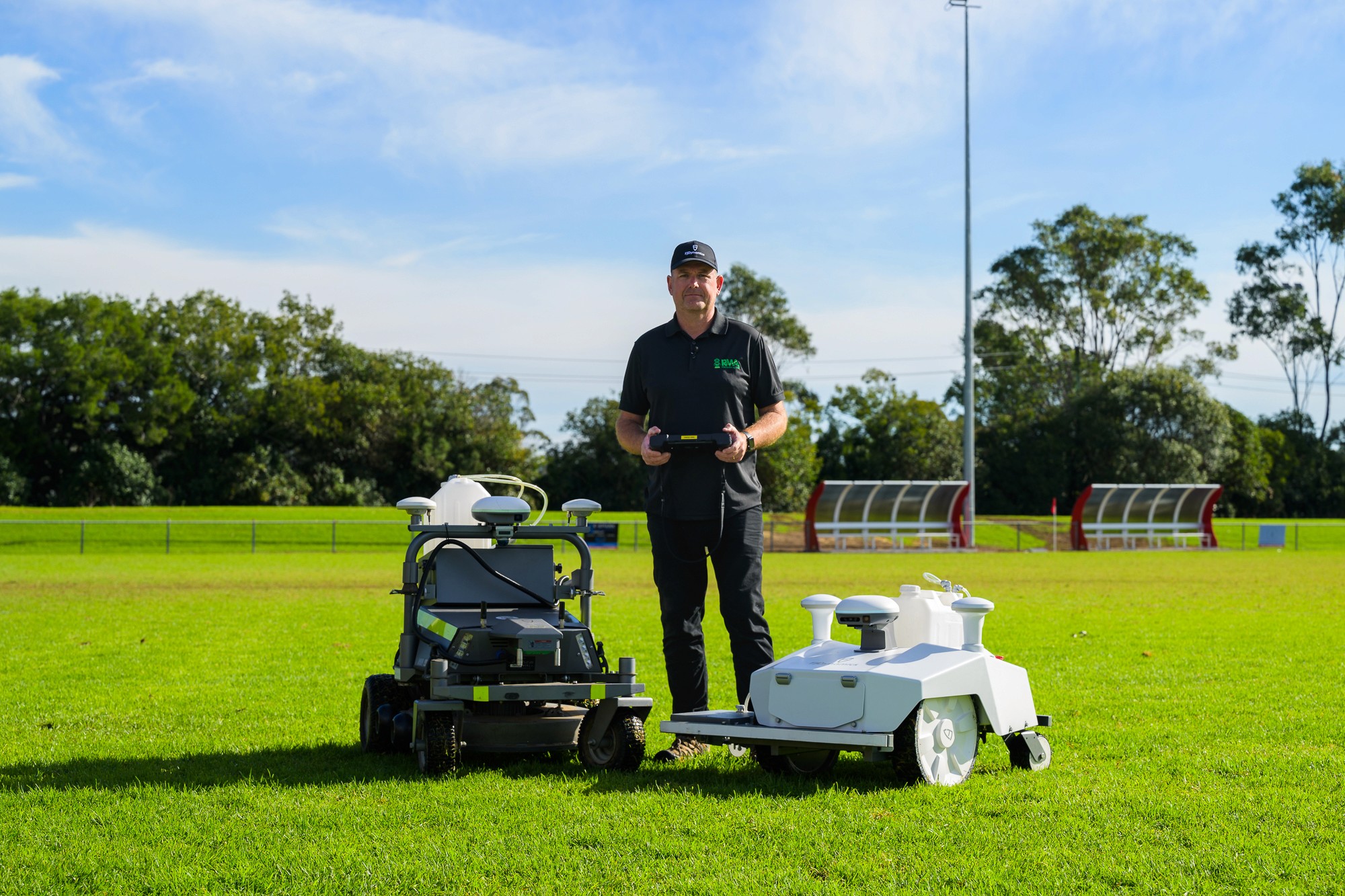
The FJD RM21 is purpose-built for commercial mowing. RTK satellite positioning combined with LiDAR creates a 3D terrain map and drives the mower in systematic parallel lines. On a sports field, the cut quality is visible.
Specification | Detail |
|---|---|
Mowing capacity | Up to 90,000 m² (9 ha) total mapped area |
Battery | 4 kWh for extended autonomous operation |
Slope handling | Up to 20° (36%) gradient |
Cutting height | 30–127 mm, adjustable |
Multi-zone | Multiple fields in one scheduled task |
Obstacle avoidance | LiDAR with three sensitivity modes |
Connectivity | Mobile app, autonomous charging, rain sensor |
Line marking | Accepts LM01/LM02 kit for integrated mow-and-mark |
The FJD RM21 is the only commercial robotic mower in Australia that can both mow and mark field lines from a single machine. The LM01/LM02 line marking kit attaches in minutes, and the same RTK positioning system guides line marking to the same centimetre accuracy.
FJ Dynamics PaintMaster Pro — autonomous sports field line marker
Best for: Sports clubs, councils, and schools automating line marking for football, soccer, rugby, cricket, or AFL ovals.
Manual field marking takes an experienced groundsperson around 3 hours per field. A less experienced operator may take twice that, with inconsistent results. The PaintMaster Pro marks the same field in under 30 minutes, to millimetre accuracy, every time.
Specification | Detail |
|---|---|
Navigation | Dual industrial GNSS receivers, centimetre accuracy |
Optional laser kit | Millimetre accuracy under canopy or near stands |
Field templates | Soccer, AFL, rugby union, rugby league, cricket, baseball, athletics, custom |
Subscription | None — purchase price is total cost |
Base station | FJ Dynamics V1 GNSS — no 4G dependency |
Kress Mission Mega RTKn — commercial autonomous mower for institutional sites
Best for: Schools, universities, councils, and commercial grounds maintenance contractors managing multi-zone sites from 8,000 m² to 28,000 m² per unit.
Kress RTKn pulls RTK correction data from a cellular network rather than an on-site antenna. No reference station, no cabling, nothing installed in the field. For facilities where running power to an antenna isn't practical, that's a real advantage.
Model | Recommended area | Max. mapped area | Application |
|---|---|---|---|
Up to 12,000 m² | 12,000 m² | Large school oval, council reserve | |
Up to 24,000 m² | 24,000 m² | Multi-field complex, large park | |
Up to 28,000 m² | 28,000 m² | Stadium surrounds, university grounds |
Additional features: MAP™ automatic path optimisation, full IoT connectivity with OTA software updates, cellular theft tracking, 3-year warranty, no antenna to maintain.
Kress Voyager KR800 — autonomous mower for commercial grounds maintenance contractors
Best for: Commercial grounds maintenance contractors, facilities management companies, and property services businesses managing parks, schools, office complexes, or cemeteries.
Availability: Request an order with Robot Mowers Australia.
Specification | Detail |
|---|---|
Cutting deck | 102 cm (40") commercial-grade |
Mowing capacity | Up to 28,000 m² per charge (~2.8 hectares) |
Runtime | Up to 8 hours per charge |
Mowing speed | Up to 9 km/h |
Slope capability | Up to 40% (22°) gradient |
Navigation | RTK satellite, centimetre-level – no boundary wires |
Obstacle detection | 360º array: LiDAR, cameras, ultrasonic |
Map memory | Stores maps for multiple properties, no re-mapping |
Multi-zone | Autonomous navigation between zones per site |
Fleet management | Integrates with Kress Fleet Management System |
Durability | Engineered for up to 5,000 hours |
Emissions | Zero direct emissions, electric only |
7. Is your site suitable for commercial robotic mowing?
Not every site is ready immediately. Here's an honest assessment of what works and what to consider before committing.
Terrain and slopes
The FJD RM21 handles slopes up to 20° (36%). Kress Mission Mega up to 35%. The Voyager up to 40% (22°). Anything steeper needs manual equipment. For most sports ovals, school grounds, and commercial properties, slope is not a barrier.
Tree canopy coverage
Heavy canopy can reduce RTK satellite signal quality. The RM21's LiDAR maintains accuracy in partial shade. Kress RTKn uses dead reckoning when satellite lines are blocked. Heavily shaded sites are worth assessing on a demonstration before purchasing.
Surface condition
Commercial robotic mowers perform best on established, reasonably even turf. Significant hollows, exposed roots, or debris accumulation should be addressed first. This is a preparation issue, not a permanent barrier.
Power access
Charging stations for the FJD RM21 and Kress Mission Mega require a standard 240V outlet. For Kress, that's the only power infrastructure needed. Nothing goes into the field itself. The Voyager charges at the depot or on-site depending on site availability.
8. Return on investment for commercial robotic mowers
Commercial robotic mowers are a capital investment, typically $15,000 to $50,000 depending on equipment and site scale. Whether the investment stacks up depends on what you're currently spending and how you account for staff time.
Illustrative ROI for a sporting club or council facility
Cost factor | Manual operation | With robotic mower |
|---|---|---|
Mowing labour (40 wks × 6 hrs × $34/hr) | $8,160 / year | $0 (automated) |
Fuel / electricity | ~$1,200 / year | ~$120 / year |
Equipment servicing | ~$800 / year | ~$200 / year |
Line marking labour (30 wks × 3 hrs × $34/hr) | $3,060 / year | $0 (with Paintmaster Pro) |
Total annual operating cost | ~$13,220 / year | ~$320 / year |
Annual saving | ~$12,900 / year |
Labour rates from Indeed Australia (2025). Clubs relying on volunteer labour won't see the dollar saving directly, but will recover volunteer hours and reduce pressure on members.
ROI for commercial grounds maintenance contractors
For a contractor, this is less about replacing equipment and more about restructuring how your crew's time is allocated across a route. When the Voyager handles mowing, the freed operator covers finishing work, client liaison, or a second site. That productivity shift applies every day, across every site, across the season.
Procurement pathways
For councils and educational institutions:
Direct purchase via your standard capital procurement process
Equipment lease or finance through third-party lenders (referrals available)
Sports infrastructure or sustainability grants for eligible councils and clubs
Budget submission support: Robot Mowers Australia can provide ROI modelling and site documentation
9. Installation, setup, and ongoing support
Correct installation is what determines whether a commercial robotic mower delivers on its potential. Buyers who purchase through generalist retailers often struggle here.
What installation involves
Site assessment: walk the property to identify zones, obstacles, slope, and charging station placement
Zone mapping: drive the mower around each area's perimeter to record virtual boundaries and paths
Charging station installation: 240V connection, mounted near a boundary fence or equipment shed
Test mow: supervised run to verify path planning and obstacle detection
Operator training: your grounds team trained on scheduling, the app, and basic maintenance
Ongoing maintenance
Blade replacement: every 4–8 weeks depending on conditions; under 10 minutes
Cleaning: rinse the undercarriage after heavy conditions; wipe sensors monthly
Software updates: automatic over-the-air for Kress; via app for FJ Dynamics
Annual service: inspection and firmware review recommended each year
Support from Robot Mowers Australia
Direct access to Dirk Streefkerk, Director, qualified horticulturist, and the person who installed and configured your equipment. Lifetime support on all supplied and installed equipment. Remote diagnostics via app for most issues. On-site service for hardware faults under warranty. Supporting over 1,000 robotic mowers operating across Australia, with commercial clients including councils, sporting clubs, schools, and commercial grounds maintenance contractors.
10. Frequently asked questions
Can a commercial robotic mower handle a full cricket or AFL oval?
Yes, in most cases. The cricket pitch surface is mapped as a no-go zone to protect the prepared wicket. The outfield is mowed normally. Different cutting heights can be set for different zones on the same site.
What happens when the mower encounters an unexpected obstacle?
The mower reroutes around it. If it can't clear the obstacle, it stops and sends an alert to the app. LiDAR-equipped models like the FJD RM21 and the Kress Voyager handle complex terrain better than basic bumper-only units.
Can the mower run during school hours?
Operating noise is under 60 dB(A), quieter than a normal conversation at close range. For active school grounds, scheduling outside school hours remains the standard recommendation even where noise isn't technically a problem.
How long does installation take?
A straightforward single-site installation takes a day. Complex multi-zone sites typically take two days. Installation is scheduled around your operations to keep disruption minimal.
For contractors: how long does it take to map a new property with the Voyager?
Most commercial sites take 30 to 60 minutes. You do it once. After that, the map is saved and the Voyager is ready to go on every subsequent visit with no setup required beyond unloading.
Does the mower stop in the rain?
All commercial models have rain sensors and return to the docking station when rain is detected. Mowing wet turf causes compaction and surface damage, so this is the correct response. The mower resumes when conditions improve, or you can restart it manually.
Are there ongoing subscription fees?
The FJD PaintMaster Pro has no ongoing subscription. The FJD RM21 uses an included GNSS base station with no network fees. Kress RTKn and Voyager use a cellular correction network. Contact Robot Mowers Australia for current subscription terms.
11. Next steps
Whether you manage turf for a sporting club, run grounds for a school or council, or operate a commercial grounds maintenance business looking to scale without adding staff, the starting point is a conversation about your specific site and route.
Robot Mowers Australia offers on-site assessments and equipment demonstrations with no obligation. We'll walk the property, give you an honest read on suitability, and recommend the right equipment or tell you straight if it's not the right fit yet.